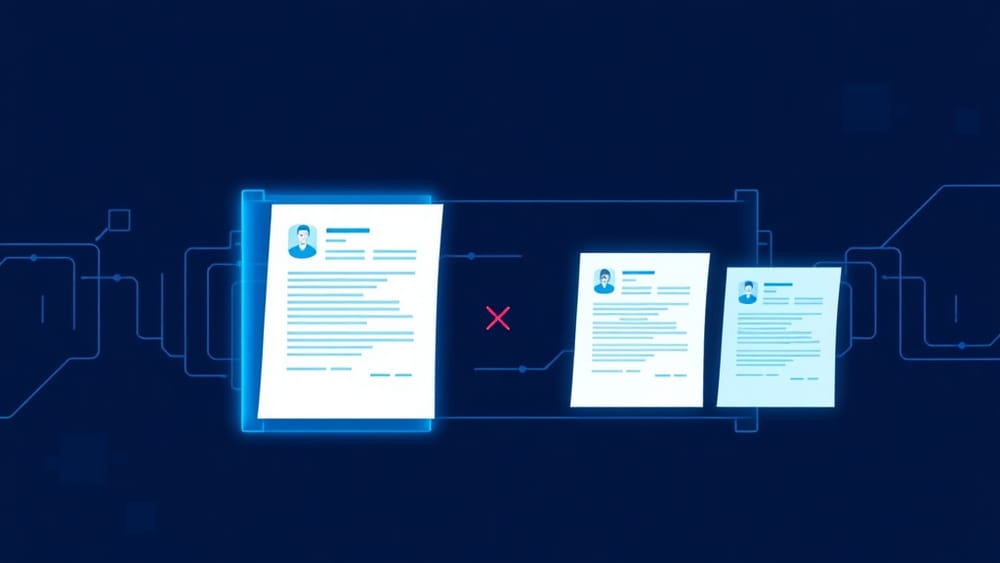
You applied. You're qualified. You heard nothing. Here's what most job seekers never find out: the problem probably wasn't your experience.
97% of large companies now use Applicant Tracking Systems to filter resumes before a human ever sees them. And the vast majority of rejections don't happen because you lacked the skills. They happen because the software couldn't read your file properly.
That's not a skills problem. That's a formatting problem. And it's fixable.
What an ATS Actually Does
An ATS doesn't read your resume the way a person does. It parses the text, pulls out structured data, and tries to match it against the job requirements. Name, contact info, job titles, dates, skills, it's looking for specific signals in specific places.
When your resume uses a format the parser wasn't built to handle, that data goes missing or gets scrambled. The system sees a blank where your job title should be, or misreads your dates, and your application scores low automatically.
You never stood a chance. Not because you weren't good enough, but because the software couldn't see you.
The Formatting Mistakes That Kill Applications
These are the most common structural errors that cause ATS parsers to fail:
Tables and columns. Two-column resume layouts look polished to a human eye. To most ATS parsers, the text gets read in the wrong order or dropped entirely. Your skills column might never get parsed.
Headers and footers. Putting your contact details in the document header seems logical. But many parsers skip headers and footers entirely. Your phone number and email may never be captured.
Graphics and icons. Logos, profile photos, icon-based skill ratings, these are invisible to ATS. Worse, they can disrupt the text flow around them and cause adjacent content to be misread.
Non-standard section titles. If you label your work history "Where I've Made an Impact" instead of "Work Experience" or "Professional Experience," the parser may not recognise it as a work history section at all.
Fancy fonts and text boxes. Anything rendered as an image or placed in a text box is unreadable to most parsers. The text simply doesn't exist from the software's perspective.
PDF files from design tools. Not all PDFs are equal. A PDF exported from Canva or Adobe Illustrator often contains the text as visual paths, not selectable characters. The parser sees a picture, not a document.
Why Career Changers Are Hit Hardest
If you're switching industries, ATS rejections sting more because the system is already working against you. Your job titles don't match the norm for the role. Your industry vocabulary is different. The parser may flag you as low relevance before a human can notice that your transferable skills are exactly what the company needs.
The fix is deliberate keyword alignment. Read the job description carefully. Mirror the exact language used for skills, tools, and role responsibilities in your resume. Don't paraphrase. If the posting says "stakeholder management," use that phrase, not "managing relationships with senior partners."
This isn't keyword stuffing. It's speaking the system's language so your actual qualifications can be seen.
What a Clean, ATS-Friendly Resume Looks Like
Here's the practical checklist:
- Single-column layout. Clean, linear, top to bottom.
- Standard section headings. Work Experience, Education, Skills, Certifications.
- Contact info in the body, not the header or footer.
- Plain fonts. Calibri, Arial, Georgia. Nothing decorative.
- Saved as a .docx or a text-based PDF. Not a Canva export.
- No tables, text boxes, or graphics.
- Job titles and dates clearly formatted on each role, consistently.
It sounds boring. It should look a little boring. The goal at this stage isn't to impress the software with design. The goal is to get the software out of the way so a human can see you.
You Can Check Before You Apply
You don't have to guess whether your resume will pass. Topapplicant, built by Novion, analyses your resume for exactly these kinds of ATS parsing issues. It checks your structure, flags formatting problems, identifies missing sections, and tells you what to fix before you submit. It takes a few minutes and it changes what happens next.
Most rejections are silent. You submit, wait, and hear nothing. But parsing errors are detectable in advance. Formatting problems are fixable. That's the part that's actually in your control.
Stop sending the same resume and hoping for different results. Find out what the ATS sees, fix it, and give your application the chance it deserves.
Improve your resume at topapplicant.novion.one.