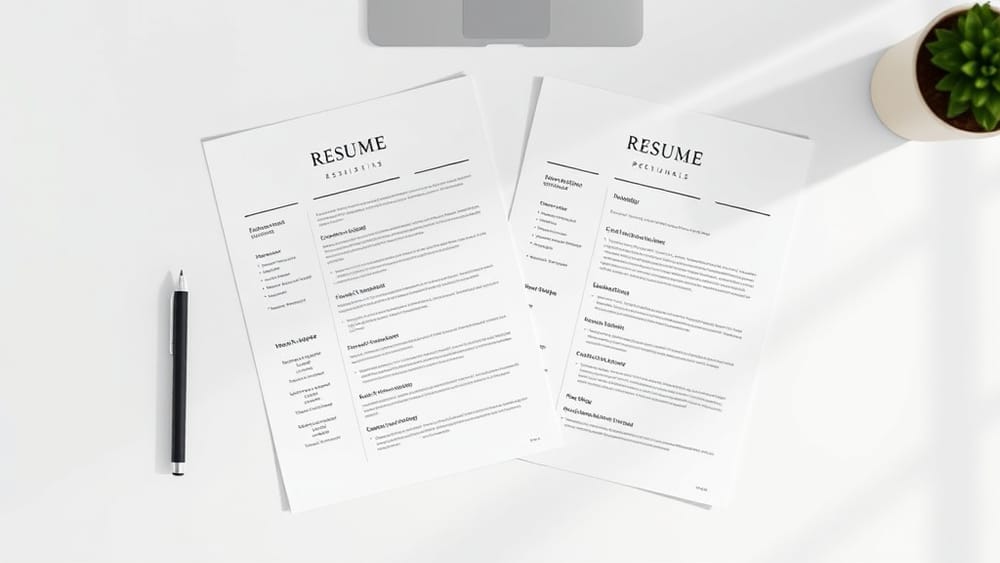
Your resume format was built for a hiring system that most employers have quietly abandoned.
About 70% of employers now use skills-based hiring, evaluating candidates on what they can do rather than where they worked and for how long. Yet the vast majority of job seekers still submit resumes that lead with job titles and employment dates, formats designed for a world that no longer exists in most hiring rooms.
This is not a small mismatch. It can cost you interviews. Here is how to read the room, choose the right format, and make sure your formatting decision actually works.
What "Skills-First" and "Chronological" Actually Mean
A chronological resume lists your work history in reverse order, most recent job first. It is the default format most people learned and most hiring managers grew up reading. It answers the question: where have you been?
A skills-first resume (also called a functional or hybrid resume) leads with a curated set of competencies, grouped by what you can do. Work history appears later, often with less emphasis on dates. It answers the question: what can you deliver?
A hybrid resume blends both. It opens with a strong skills summary, then shows a clean chronological history underneath. For most job seekers in 2026, this is the format worth considering first.
When to Use Each Format
There is no universal right answer. The format that wins is the one that fits the hiring context.
Use chronological when:
- You have a steady, relevant work history in the same field
- You are applying to traditional industries like law, finance, or government
- The job posting emphasises company names and years of experience
- You are not making a significant career change
Use skills-first or hybrid when:
- You are changing industries or roles and your job titles do not match the target role
- You have employment gaps you do not want front and centre
- You are re-entering the workforce after a career break
- Your most impressive experience is freelance, contract, or project-based
- The job posting is loaded with specific skill and competency language
The shift toward skills-based hiring means that more job postings now explicitly list required competencies, not just preferred backgrounds. If a posting reads like a skills checklist, your resume should too.
Why Format Alone Will Not Get You the Interview
Here is the part most resume format guides skip: switching from chronological to skills-first does nothing on its own if your keywords are wrong.
Every resume that enters a modern hiring pipeline goes through an Applicant Tracking System (ATS) before a human reads it. ATS software scans for specific terms pulled directly from the job description. It does not care how elegant your layout is. It cares whether your resume contains the words it is looking for.
This means:
- Your skills section must mirror the language in the job posting. If the posting says "data visualisation" and your resume says "chart creation," the ATS may not connect them.
- Job titles matter more than you think in ATS parsing. Even on a skills-first resume, your past job titles are scanned and matched against expected role hierarchies.
- Formatting that looks clean to a human can confuse an ATS. Tables, columns, icons, and text boxes often get parsed incorrectly or skipped entirely.
Format and keyword alignment are two separate levers. You need to pull both.
A Practical Framework for Choosing Your Format
Before you reformat your resume, answer these three questions:
1. Does my work history directly support the role I want?
If yes, chronological or hybrid. If no, hybrid or skills-first.
2. Is the job posting focused on skills and outputs, or on credentials and years of experience?
Skills-focused posting: lead with skills. Credentials-focused posting: lead with history.
3. Will this resume go through an ATS before a human sees it?
Almost certainly yes for any mid-size or large employer. That means your formatting needs to be ATS-clean regardless of which structure you choose. Single-column layouts, standard section headers, and no graphics are your safest bets.
Once you have answered those three questions, the format decision becomes much clearer.
The Format That Works Best in Most Cases Right Now
For most job seekers in 2026, a clean hybrid resume is the practical default. Here is the basic structure:
- Contact information (name, phone, email, LinkedIn, location optional)
- Professional summary (3-4 lines, keyword-rich, focused on your value)
- Core skills or competencies (a tight list of 8-12 relevant skills pulled from the job posting)
- Work experience (reverse chronological, achievement-focused bullet points)
- Education and certifications
This structure satisfies an ATS because it is clean and keyword-dense at the top. It satisfies a skills-based hiring manager because competencies are visible immediately. And it still gives a traditional hiring manager the work history they want.
The skills section is not a dumping ground. Each item should be a term that appears in your target job postings and that you can genuinely back up with examples in the experience section below.
Resume format is a real decision with real consequences, but it is one piece of a larger puzzle. The job seekers getting callbacks in 2026 are the ones who match the right format to the right context and then make sure every keyword, every bullet point, and every section header is working toward the same goal.
Topapplicant, built by Novion, analyses your resume against the job you want, flags ATS issues, and tells you exactly where your format and keywords are falling short. Improve your resume at topapplicant.novion.one.