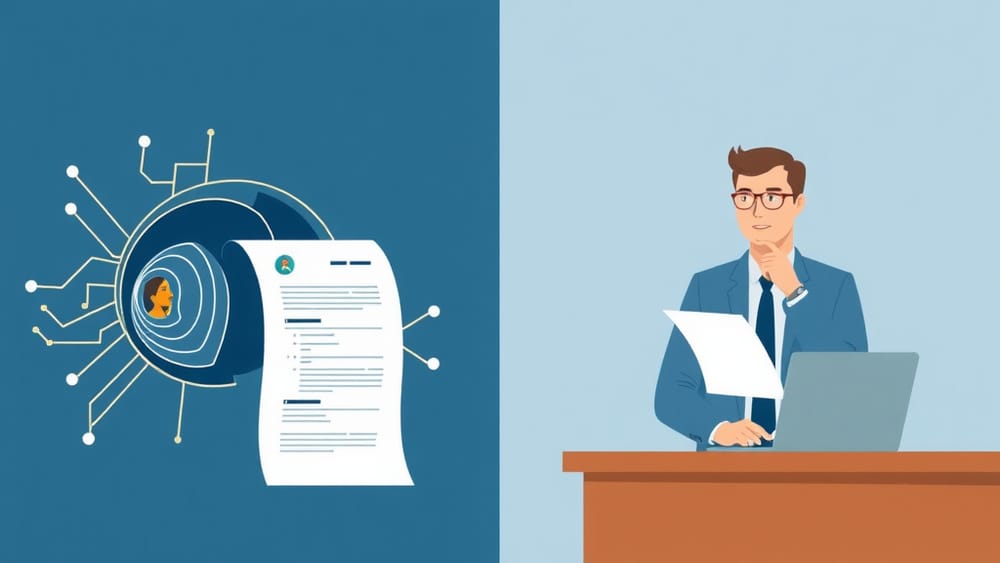
Your resume now has two readers. They want opposite things. And both can end your application before a human ever calls you.
AI screening tools favour resumes that are structured, keyword-rich, and cleanly formatted. Hiring managers hate resumes that feel like they were generated in 30 seconds by a chatbot. The same resume that sails through an ATS can land in the rejection pile the moment a real person opens it.
This is the AI screening double bind. Here is how to escape it.
What the Research Actually Shows
A 2024 study found that AI screening tools preferred AI-written resumes at an 82% rate over human-written ones. The reasons are predictable: better keyword density, consistent formatting, clear section hierarchy, and language that maps neatly onto job descriptions.
But flip to the hiring manager side and the picture reverses. Recruiters and hiring managers are now trained, consciously or not, to spot AI-generated text. Generic phrasing, suspiciously smooth transitions, and the total absence of a real person's voice set off alarms. Candidates who sound like every other candidate get screened out, just at a later stage.
The problem is not AI. The problem is using AI wrong.
What AI Does Well on a Resume
AI tools are genuinely useful for the structural layer of your resume. That includes:
- Keyword alignment. AI can scan a job description and flag missing terms your resume should include. This directly affects ATS scoring.
- Section structure. Clear, predictable headings (Experience, Skills, Education) help parsing algorithms read your document correctly.
- Formatting consistency. Uniform date formats, bullet length, and spacing reduce parsing errors.
- Initial draft speed. AI can produce a usable skeleton faster than starting from a blank page.
Think of AI as the scaffolding. It builds the shape. It does not build the building.
Where Human Voice Is Non-Negotiable
Everything that makes a hiring manager want to interview you has to come from you. That means:
Specific metrics. "Reduced onboarding time by 40% across a 12-person team" is human. "Improved processes to increase team efficiency" is AI. One is memorable. One is wallpaper.
Real context. Why did that project matter? What was the constraint you worked under? AI cannot know that you shipped a product in six weeks during a hiring freeze. You can.
Your actual voice. Word choice, sentence rhythm, the occasional short declarative sentence. Hiring managers read dozens of resumes. The ones that sound like a real person thinking clearly stand out.
Honest gaps and pivots. If you are changing careers, your summary needs to explain the logic of that move in your words, not in template language. A career change summary written by AI sounds like it was written for everyone. Yours needs to sound like it was written for you.
The Hybrid Approach in Practice
Here is a repeatable process that satisfies both readers:
- Start with the job description. Identify the five to eight most repeated skills and requirements.
- Use AI to check your keyword coverage. Run your current resume against those terms and add what is genuinely missing.
- Let AI suggest structure, not sentences. Use it to reorganise sections or flag formatting inconsistencies.
- Rewrite every bullet in your own voice. Take the AI draft and ask: does this sound like something I would actually say? If not, rewrite it.
- Add a number to every achievement you can. Percentages, revenue figures, team sizes, timeframes. These are the details AI cannot fabricate on your behalf.
- Read the whole thing out loud. If it sounds like a press release, it needs more human editing.
The goal is a resume that an ATS can parse perfectly and a hiring manager can actually read without their eyes glazing over.
The Mistake That Kills Candidates at Both Stages
The worst outcome is a resume that fails both tests: too generic for a hiring manager to care about, and too poorly structured for an ATS to score well. This happens when job seekers copy-paste a ChatGPT output and change the name at the top.
The second worst outcome is over-correcting. Refusing to use any AI tools because you want to stay authentic means you may miss keyword gaps that cost you an ATS pass. The 82% preference rate for AI-assisted structure is a signal worth taking seriously.
The winning position is deliberate. Use AI for the architecture. Show up yourself for everything that matters.
Topapplicant analyses your resume against both dimensions, checking ATS keyword gaps and flagging sections that read as generic or unconvincing. It is built by Novion specifically to help job seekers navigate exactly this kind of double standard.
The two readers are not going away. The candidates who figure out how to satisfy both are the ones getting interviews.
Improve your resume at Topapplicant and see exactly where your resume stands with both readers.